
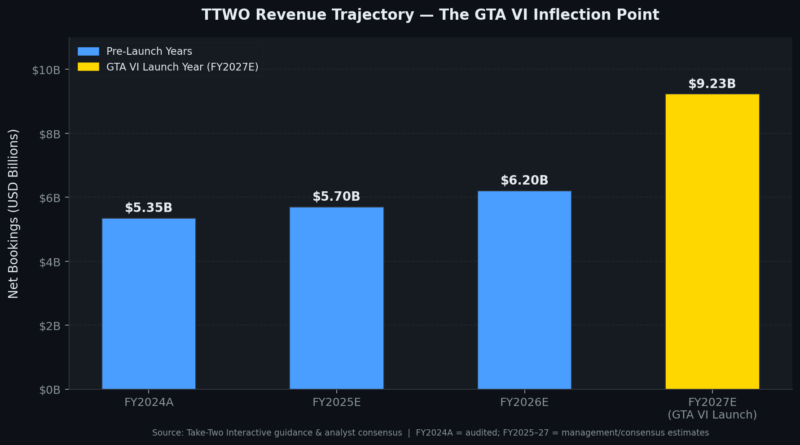
Take-Two Interactive Software (NASDAQ: TTWO) is trading near a fresh 52-week low — and the most sophisticated institutional money on Wall Street is treating that as a gift. With GTA VI locked in for a November 19, 2026 launch and management projecting a near-doubling of revenue to $9.23 billion in fiscal year 2027, the bull case isn’t subtle. What is subtler is how well the underlying business is actually performing right now — and why that matters enormously to risk-adjusted return on this trade.
At a Glance: The TTWO Investment Scorecard
| Metric | Value | Signal |
| Current Share Price | ~$190 | Near 52-wk low |
| YTD Price Decline | -23% | Macro selloff |
| Analyst Median PT | $277 | +46% upside |
| Buy / Hold / Sell | 17 / 2 / 0 | 17 of 19 Buy |
| Q3 Net Bookings | $1.76B | +10.7% beat |
| Recurring Rev. Mix | 77% | Structural moat |
| Institutional Ownership | 95% | High conviction |
| UBS New Position | $275.8M | +13% stake increase |
| FY2027E Revenue | $9.23B | GTA VI launch year |
| GTA VI Launch Date | Nov 19, 2026 | Confirmed |
Source: Bloomberg, Take-Two Q3 FY2025 Earnings, institutional 13-F filings, March 2026
1. The Macro Dislocation Is Not a Fundamental Deterioration
TTWO’s 23% year-to-date decline is not a story about deteriorating fundamentals — it is a story about macro sentiment crushing a growth-oriented equity. Rising energy prices above $100 per barrel and stagflation fears tied to geopolitical friction between the U.S. and Iran have punished the entire Communication Services sector. TTWO shares shed nearly 4% in a single session as the sector logged its fifth consecutive weekly loss.
This distinction — macro selloff versus fundamental impairment — is the most important analytical call any equity investor makes. When the two diverge, as they have here, it creates the asymmetric entry points that institutional portfolios are built to exploit.
| The business hasn’t gotten worse. The stock price has. Those are different statements — and conflating them is how retail investors consistently sell at the bottom. |
2. The Q3 Earnings Beat Signals Real Operating Momentum
In its most recent quarter, Take-Two posted net bookings of $1.76 billion — a $170 million beat against the Street consensus of $1.59 billion, representing an outperformance of approximately 10.7%. This is not noise. A beat of that magnitude, on a top-line metric as closely watched as net bookings, signals genuine demand durability in the franchise portfolio.
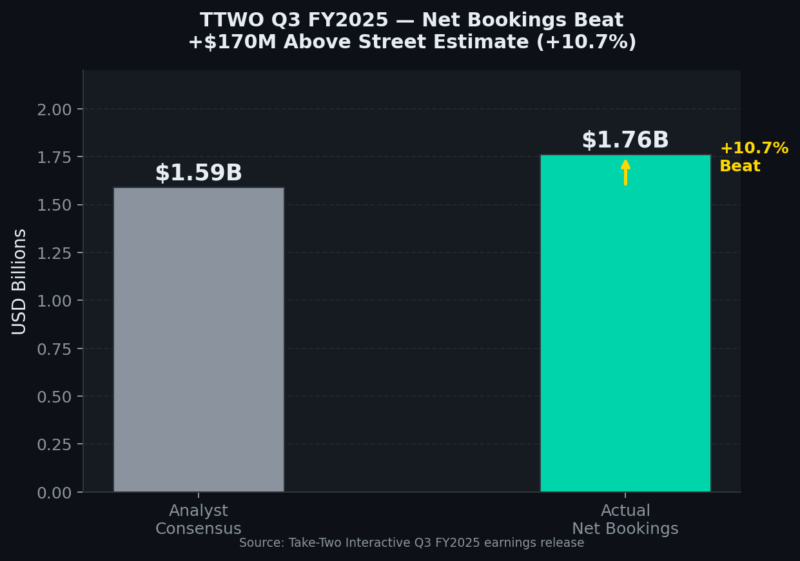
The critical nuance: net bookings is the correct lens for a game publisher’s operating health — far more so than GAAP revenue, which is subject to deferred revenue treatment on multi-element arrangements. When net bookings beats by more than 10%, the operating engine is running hot.
3. 77% Recurring Revenue Is the Structural Moat That Nobody Is Talking About
The headline that should be getting more attention: 77% of Take-Two’s Q3 GAAP revenue came from recurrent consumer spending — a category that includes GTA Online, NBA 2K26’s virtual currency and MyTeam modes, and the Zynga mobile portfolio of social and casual games. This is not a title-by-title hit-driven publishing model. This is a platform business with recurring monetization rails.
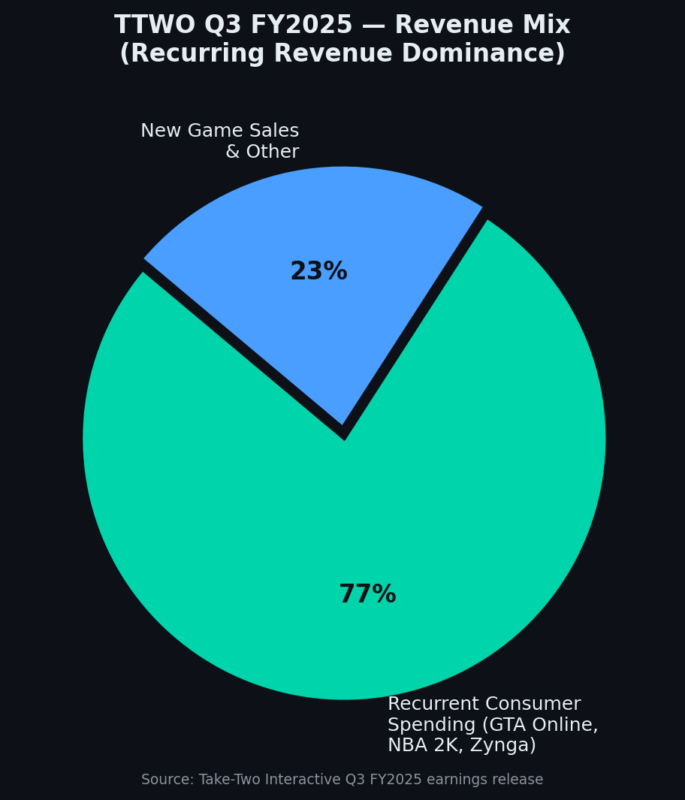
Fig. 3 — TTWO Q3 FY2025 Revenue Mix: Recurrent consumer spending accounts for 77% of GAAP revenue
To put that in context: a 77% recurring revenue mix is exceptional for a video game publisher. Electronic Arts (EA) and Activision Blizzard (pre-Microsoft acquisition) spent years building franchise live-service ecosystems to achieve similar ratios. The fact that TTWO has arrived here — with GTA VI not yet contributing a single dollar — means the base business already provides substantial downside protection regardless of what happens at launch.
| GTA Online has been generating live-service revenue for over a decade. NBA 2K has embedded microtransaction mechanics with one of the most loyal sports gaming audiences in the world. Zynga brings 183 million average monthly mobile users. These are not speculative assets — they are cash machines. |
4. Institutional Accumulation at 52-Week Lows — Reading the Smart Money Signal
On March 29, 2026 — one day before the stock was trading near its 52-week low — UBS Group AG disclosed a near-13% increase in its TTWO position, acquiring approximately 1.08 million additional shares in a transaction worth approximately $275.8 million. This is not a passive rebalancing trade. A discretionary increase of that size, at that price point, reflects an active high-conviction decision by one of the world’s largest asset managers.
Institutions now own 95% of TTWO’s outstanding shares. That concentration cuts both ways: it reflects deep, sophisticated consensus around the investment thesis; but it also means there is very little retail absorption capacity if the thesis breaks. When 95% of holders are professional money managers all watching the same catalyst — GTA VI — the behavioral dynamics around launch will be compressed and potentially volatile.
The sophisticated read: institutional accumulation at 52-week lows tells you that long-duration money has stress-tested the downside scenario and concluded the risk/reward is favorable at $190. What it does not tell you is whether the stock reaches $277 before or after the catalyst, or how it reacts to post-launch data in the first two quarters.
5. The Wall Street Consensus — And Why 17/19 Buys Deserves Scrutiny
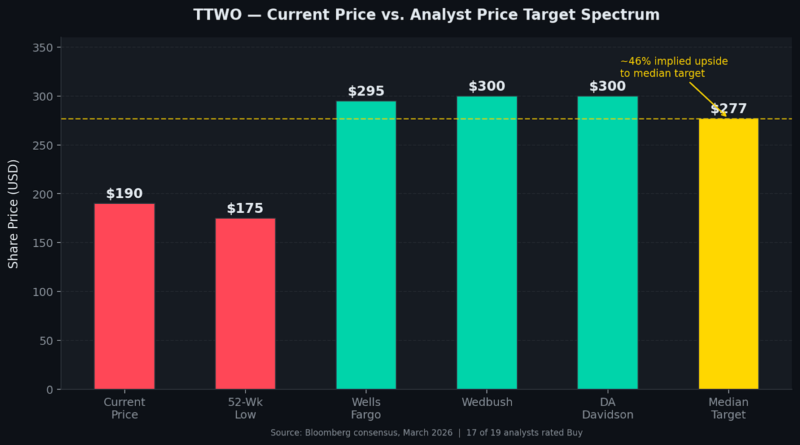
Fig. 4 — TTWO Price Target Spectrum: Current price ~$190 vs. median analyst target of $277
DA Davidson, Wells Fargo, and Wedbush each carry price targets in the $295–$300 range. The median across 19 sell-side analysts is $277 — implying approximately 46% upside from current levels. Notably, DA Davidson’s Buy thesis is anchored in strong user engagement metrics for NBA 2K26; Wedbush cites improvements in mobile payment infrastructure within Zynga’s game suite as a leading indicator of higher average revenue per user (ARPU).
However, a 17-of-19 Buy consensus warrants analytical caution. At that level of uniformity, the market has already largely priced the bull case into analyst expectations. The marginal upgrader has nowhere to go — and the asymmetric risk is that any one of those 17 Buy-rated analysts downgrades on a miss, triggering cascading institutional selling among holders who are all watching the same report.
| Analyst consensus is a lagging indicator, not a leading one. The 17/19 Buy rating tells you where sentiment was — not where the stock is going. The real question is whether the two remaining Hold analysts flip to Sell on any post-launch underperformance. |
6. The GTA VI Thesis — What Needs to Be True
At its core, the TTWO investment case is a binary event wager structured around a single title. The November 19, 2026 launch of GTA VI is not just a catalyst — it IS the fiscal year. Management’s $9.23 billion FY2027 revenue projection represents a near-doubling from current run-rate levels. For context, GTA V generated approximately $800 million in opening weekend revenue upon its 2013 launch — before the decade-long GTA Online monetization engine that followed.
For the thesis to work, three conditions must hold simultaneously:
- Launch date holds. Any delay beyond November 2026 is a stock catalyst in the wrong direction — the market has begun pricing FY2027 guidance, and a slip would reset expectations dramatically.
- Critical reception meets commercial expectations. A Metacritic score below 85, or early controversy around content or technical issues, could dampen the attach rate and suppress day-one sales velocity.
- GTA Online 2.0 replicates the monetization flywheel. The most durable upside — and the one that justifies $300 price targets — is not the box sales but the recurring live-service monetization over the 5-10 years post-launch. That is what turns a $9.23B FY2027 into a structural re-rating of the company’s earnings power.
Key Risks to the Bull Thesis
| Risk Factor | Potential Impact |
| GTA VI launch delay | Immediate stock re-rating; FY2027 guidance becomes irrelevant |
| Macro stagflation deepens | Consumer discretionary spend contracts; unit sales miss launch-week targets |
| Concentrated institutional ownership (95%) | Correlated selling risk on any negative surprise; thin retail buffer |
| Analyst consensus overextension (17/19 Buy) | Limited upgrade capacity; downgrade risk elevated on any miss |
| GTA VI Online monetization underperforms | Long-term earnings power narrative collapses; multiple compression |
| Debt load from development spend | Rising rates increase cost of capital; FCF conversion compressed near-term |
The Bottom Line
Take-Two Interactive at $190 is a high-conviction institutional trade with a clearly defined catalyst, a genuinely strong underlying recurring revenue business, and a Wall Street consensus that has stress-tested the downside. The 23% YTD decline is a macro artifact, not a fundamental indictment. The smart money knows this — which is why UBS just paid $275 million to add to its position the day before the stock hit a fresh 52-week low.
The trade is not without risk. The 95% institutional concentration, the binary nature of the GTA VI launch, and the stretched analyst consensus all create scenarios where the stock moves violently in either direction on any meaningful data point between now and November. This is not a stock for the faint of balance sheet.
But for investors with the time horizon and conviction to hold through eight months of macro-driven noise, the asymmetry is compelling: a proven live-service business generating $1.76 billion in quarterly net bookings, supported by institutional conviction, trading at a 46% discount to the consensus fair value estimate — with the single largest video game launch in history eight months away.
| The question is not whether GTA VI will be successful. The question is whether the post-launch monetization flywheel rewrites the long-term earnings power of the business permanently — the same way GTA Online did in 2013. If the answer is yes, $277 is a floor, not a ceiling. |



It’s interesting to see TTWO at this level, especially with the recent performance. I wonder if the upcoming GTA 6 release will shift the narrative.