
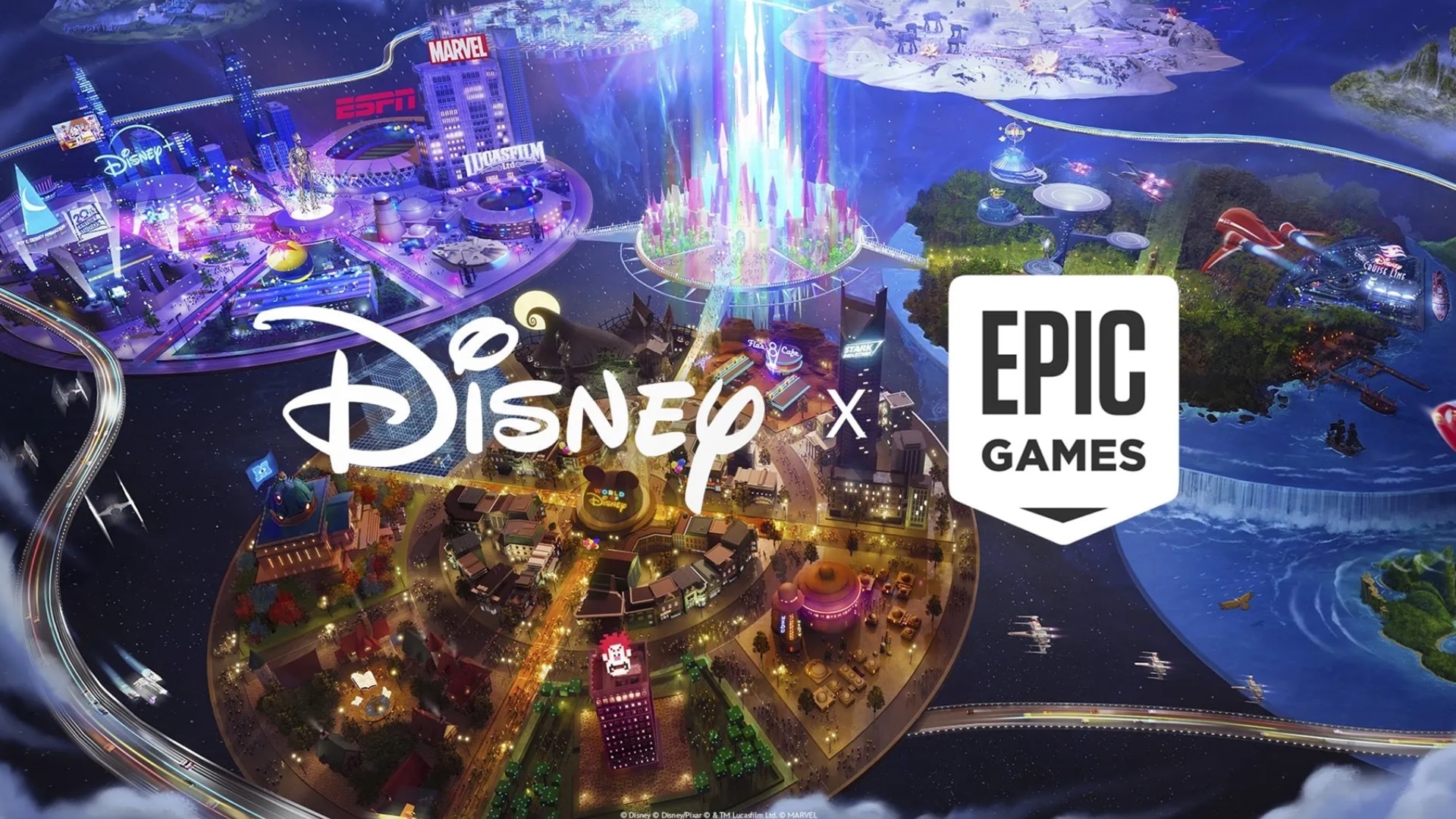
While Disney’s $1.5B opening bet on Epic Games was the right call, the company’s stock price could take a hit if it seeks to listen to its former employee.
Doubling down through a structured minority stake expansion is the wealth-creating move. A full buyout is the value-destroying one.
| By Taimoor Khan | PressPlayFinance.com | March 31, 2026 · DIS Equity Analysis · Rating: HOLD |
KEY FINANCIAL SNAPSHOT
| Metric | Value | Benchmark | Signal |
| DIS Stock Price (NYSE) | ~$92.42 | 52W High: $124.69 | ↓ 25.9% off highs |
| Market Capitalisation | ~$167B | MSFT: $2.9T | Large-cap |
| Trailing P/E (Norm.) | 16.3x | S&P 500 Avg ~21x | Discount to market |
| Last Qtr Revenue | $25.98B | Beat est. $25.70B | 3.77% EPS surprise |
| Last Qtr Net Income | $2.40B | vs. $1.31B prior Q | +83% QoQ |
| Dividend Yield | 1.35% | Semi-annual pmt | Modest income play |
| 5Y Market Cap CAGR | -6.32% | ATH: $197.26 (2021) | Value erosion |
| Epic Games Est. Val. | ~$32B (2022 round) | EA deal: $55B | Private — no float |
| Disney’s Epic Stake | $1.5B invested | ~4–5% est. equity | Minority position |
| PPF Rating (DIS) | HOLD | Next Earnings: May 13 | Watch gaming KPIs |
THE MAYER THESIS — AND WHY IT IS HALF RIGHT
Former Disney and TikTok executive Kevin Mayer, now running Candle Media, recently told CNBC that incoming Disney CEO Josh D’Amaro needs to take ‘bold steps’ in gaming — potentially acquiring Epic Games outright. The headline grabbed attention for good reason: Fortnite commands over 100 million monthly active users at its peak, and the Unreal Engine underpins a significant share of global AAA game development. On the surface, the strategic logic is compelling.
But Mayer is a strategist, not an equity investor. And when you stress-test his argument against Disney’s actual balance sheet, the leverage math, the founder control dynamics at Epic, and the current macro environment for M&A financing — the full acquisition thesis collapses. What survives, however, is a more precise and financially defensible version of his argument: Disney should increase its stake in Epic Games strategically, not consume it entirely.
This is not a semantic distinction. The difference between a controlled minority expansion and a full acquisition is the difference between a catalyst for DIS stock re-rating upward and a catalyst for a multi-year value destruction cycle. Let us walk through both scenarios, grounded in the numbers.
| “Disney needs Epic’s economics. It cannot afford Epic’s price tag — and Tim Sweeney isn’t selling anyway.” |
THE BALANCE SHEET ARGUMENT: DISNEY CANNOT ABSORB A $40–60B ACQUISITION
Disney is not a cash-rich technology company. As of its most recent quarterly filing, DIS carries a market capitalisation of approximately $167 billion against a trailing revenue run-rate of roughly $91 billion annually — a price-to-sales multiple that leaves little room for dilutive mega-deals. The company’s net income for the most recently reported quarter came in at $2.40 billion, a recovery that beat consensus but still reflects an organisation managing significant structural headwinds in its linear television segment.
Epic Games’ last primary funding round in 2022 valued the company at approximately $32 billion. However, that figure predates the EA acquisition precedent — PIF-led investors are acquiring Electronic Arts for $55 billion, setting a new benchmark for premium live-service gaming assets with IP breadth and platform infrastructure. A full Disney acquisition of Epic, if it were ever to happen, would almost certainly command a similar or elevated premium. Institutional bankers would anchor negotiations north of $40 billion, with a credible ceiling approaching $55–60 billion once control premiums and synergy multiples are layered in.
The leverage implication is severe. Disney’s current net-debt-to-EBITDA ratio already reflects the legacy of the 2019 Fox acquisition and pandemic-era liquidity drawdowns. A $45–55 billion deal — even partially financed through equity — would push leverage to levels that would immediately pressure Disney’s investment-grade credit rating, constrain free cash flow for dividends and buybacks, and almost certainly trigger a negative re-rating of DIS shares in the near term regardless of the strategic merits.
In an environment where the Federal Reserve’s rate posture remains uncertain and the cost of acquisition financing is structurally elevated versus the zero-rate era, debt-funded M&A at this scale requires extraordinary conviction. Disney’s board does not have that runway on its current balance sheet.
THE STRUCTURED STAKE-DEEPENING PLAYBOOK: HOW IT WORKS FINANCIALLY
The smarter path — and the one that should genuinely excite DIS equity investors — is a structured expansion of Disney’s existing $1.5 billion Epic position toward a 15–25% consolidated minority stake. This is not a consolation prize. It is a precisely engineered value-creation strategy with distinct advantages over full ownership.
First, at a 15–25% stake level, Disney retains the ability to equity-account for Epic’s earnings on its consolidated income statement — meaning a portion of Fortnite and Unreal Engine’s profitability flows directly to Disney’s reported EPS without the full cost, integration risk, or regulatory burden of outright acquisition. This is how large media conglomerates historically extract value from adjacent platform ecosystems without assuming operational control.
Second, a stake in the $3–6 billion range — a follow-on to the existing $1.5 billion — is fundable without meaningful leverage stress. Disney’s operating cash flow generation, currently running at mid-to-high single-digit billions annually, can absorb a transaction of this size across two to three fiscal years without impacting the dividend, suspending buybacks, or triggering credit-agency scrutiny.
Third, and most critically from a governance standpoint: Tim Sweeney controls Epic through super-voting shares and has shown zero public appetite for a sale. A minority stake expansion does not require his philosophical agreement to cede control — it requires only his agreement to continue accepting capital on terms favourable to both parties. Given that Disney’s IP pipeline (Star Wars, Marvel, Pixar) is among the most valuable creative inventory Epic could ever integrate into Fortnite’s live-service ecosystem, Disney has genuine negotiating leverage in this conversation that no other potential investor can replicate.
| “A 15–25% stake in Epic gives Disney the economics without the execution risk — and it’s fundable without breaking the balance sheet.” |
WHAT THE MARKET IS ALREADY PRICING IN
DIS shares are currently trading at approximately $92.42, representing a 25.9% discount to their 52-week high of $124.69 and a 5-year CAGR in market capitalisation of negative 6.32%. The stock is priced, in effect, as a legacy media conglomerate navigating secular headwinds in linear television — not as a company with optionality on the most-played live-service game in history and the world’s most-used game development engine.
That mispricing is the investment thesis for a selective DIS position today, conditioned entirely on whether D’Amaro can articulate and execute a credible digital and gaming growth narrative. The market will not re-rate DIS on the basis of a rumoured acquisition — it will re-rate on the basis of demonstrated strategic execution with measurable KPI milestones.
The Disney x Fortnite UEFN Star Wars integration — with creator tools formally launching May 1 — is the first data point the street will scrutinise. Engagement metrics, monthly active creator counts, and branded content revenue attribution will begin to form a pattern that institutional analysts can model. If those numbers are strong, they provide the empirical foundation for a stake-deepening announcement to land as a positive surprise rather than a balance-sheet concern.
THE UNREAL ENGINE PREMIUM — THE STRATEGIC ASSET THE BULLS MISVALUE
Most financial analysis of this debate focuses exclusively on Fortnite’s DAU and cosmetic revenue. That framing systematically undervalues the most important asset in the Epic portfolio: Unreal Engine. Unlike Fortnite — a consumer-facing live-service title with inherent churn risk — Unreal Engine is a B2B platform with enterprise adoption across AAA game development, major film and television production pipelines, automotive design, and architectural visualisation.
Unreal Engine exhibits many of the characteristics that SaaS investors pay premium multiples to own: high switching costs, multi-year enterprise contracts, a growing developer ecosystem that strengthens the product through network effects, and near-zero marginal cost for incremental licensing. The royalty and licensing revenue that Epic derives from Unreal Engine is structurally more durable than Fortnite’s cosmetic spend, and it sits in a category where Disney — through its studio production infrastructure — is already a natural enterprise customer.
A minority stakeholder in Epic with deep contractual IP integration would, over time, develop an information advantage about Unreal Engine’s product roadmap and revenue trajectory that is not available to any external investor. That asymmetric access — formalized through board observer rights at a 20%+ stake level — is worth a meaningful premium above the raw equity price. It creates strategic optionality that a 100% acquisition would actually destroy, because full integration would trigger competitive concerns from the thousands of third-party developers who currently rely on Unreal Engine as a neutral platform.
SCENARIO ANALYSIS: Disney Epic Games stake DIS stock
| Scenario | Deal Size | Debt Impact | DIS Price Target | Probability |
| Full Acquisition (100%) | $40–60B | +3.0–4.0x leverage | $65–75 bear case | ~10–15% |
| Deepened Stake (15–25%) | $3–6B | +0.2–0.4x leverage | $105–120 bull case | ~35–40% |
| Status Quo (no change) | $0 | No change | $88–95 base case | ~45–55% |
The scenario analysis above illustrates the asymmetric return profile clearly. A full acquisition — assuming financing can even be arranged — introduces leverage stress, integration risk, and regulatory overhang that could compress DIS shares into the $65–75 range in a bear realisation. The deepened minority stake, by contrast, is a manageable capital deployment that could serve as a re-rating catalyst toward $105–120 on a 12–18 month basis if execution evidence accumulates. The status quo — the most likely near-term outcome — keeps the stock range-bound near current levels.
| “The full acquisition destroys the neutral platform value that makes Unreal Engine indispensable to the industry. Minority ownership preserves it.” |
HISTORICAL CONTEXT: DISNEY INTERACTIVE STUDIOS AND THE COST OF OVERREACH
Institutional memory matters in M&A. Disney previously operated its own internal game development organisation, Disney Interactive Studios, which was shut down in 2016 alongside the discontinuation of Disney Infinity — a toys-to-life franchise that represented hundreds of millions in write-downs. That failure was not principally a product failure; it was an organisational integration failure. Disney’s corporate culture and operational cadence are structurally misaligned with the creative autonomy and iterative risk-taking that defines successful game studios.
Acquiring a 4,000-person engineering and creative organisation like Epic — an entity that functions more like a technology platform company than a traditional publisher — and integrating it into Disney’s content bureaucracy would risk exactly the same outcome: talent attrition, creative stagnation, and the slow suffocation of the very product qualities that made the asset valuable in the first place. The games industry is littered with exactly this pattern: Microsoft-Rare, EA-Bullfrog, Activision-Bizarre Creations.
A structured minority stake avoids this entirely. Epic remains independent, Tim Sweeney retains operational control, and Disney participates in the economics as a financial and strategic partner — not as a parent forcing corporate integration. This is the Microsoft-OpenAI model applied to gaming, and it is precisely the structure that creates durable value without the execution risk.
THE INVESTMENT VIEW: HOLD WITH A STRATEGIC CATALYST WATCH
PressPlayFinance rates DIS at HOLD at current price levels. The stock is not expensive on a normalised earnings basis — a P/E of 16.3x against a market that trades at approximately 21x is a meaningful discount. Parks and Experiences remain a high-quality, cash-generative segment. Streaming profitability has improved structurally. And D’Amaro’s background as a Parks and Experiences executive — combined with his vocal enthusiasm for gaming — positions him as a credible architect of a digital growth strategy.
However, a HOLD is not a BUY without a visible catalyst. The conditions for an upgrade to BUY are clear: a formalised announcement of an increased Epic Games equity stake in the 15–25% range, accompanied by specific Fortnite monetisation metrics from the UEFN Star Wars launch, and evidence that D’Amaro can articulate gaming revenue as a distinct line item in Disney’s financial reporting. When those three elements converge, the re-rating thesis becomes investable.
A full Epic acquisition, if announced, should be treated as a near-term sell signal regardless of the long-term strategic narrative — until the balance sheet implications and regulatory timeline are fully understood. The playbook is patient accumulation on dips, with a tight eye on gaming KPI disclosures at the May 13 earnings call. That is where the next chapter of the DIS investment thesis will be written.
INVESTMENT DISCLAIMER: This analysis is published by PressPlayFinance.com for informational and educational purposes only. Nothing contained herein constitutes investment advice, a solicitation, or a recommendation to buy, sell, or hold any security. All figures are sourced from publicly available financial data as of March 31, 2026. Past performance is not indicative of future results. Readers should conduct their own independent due diligence before making any investment decisions.

I agree, it makes perfect sense to explore the metaverse with Epic – it’s a smart long-term strategy for Disney.