

Ubisoft in doldrums as employees launch international strike as a response to restructuring announcement.
In early 2026, over 1,200 Ubisoft employees launched an unprecedented international strike in response to the company’s dramatic restructuring announcement. This labor action represents the culmination of years of financial decline that saw Ubisoft lose 95% of its market value since 2018, plummeting from a peak of approximately €10 billion to under €500 million. The restructuring, which Ubisoft termed a ‘major reset,’ included the closure of multiple studios, cancellation of six games, layoffs affecting hundreds of employees, and a mandatory five-day return-to-office policy. This analysis examines the financial performance data, strategic missteps, and operational failures that forced Ubisoft to implement such severe measures, ultimately triggering one of the largest worker strikes in gaming industry history.
Financial Performance Overview: A Downward Spiral
FY 2024-25: The Breaking Point
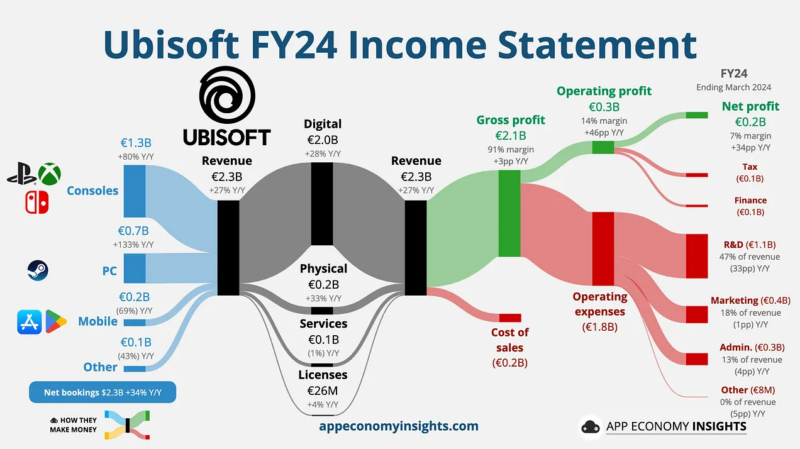
Ubisoft’s fiscal year ending March 31, 2025, marked a critical inflection point in the company’s financial trajectory. The publisher reported operating losses of €82.6 million ($92.4 million) on revenue that declined 17.5% year-over-year to €1.89 billion. More critically, net bookings—a key performance indicator for game publishers that includes digital and physical sales plus subscription revenue—fell 20.5% to €1.84 billion, significantly below market expectations.
The financial deterioration was particularly alarming given that Ubisoft had successfully completed its initial €200 million cost-reduction program ahead of schedule. Despite cutting its fixed cost base from €1.75 billion in FY 2022-23 to a target of €1.55 billion, the company still could not achieve profitability. This failure highlighted a fundamental problem: Ubisoft’s revenue decline was outpacing its ability to reduce costs, creating a dangerous downward spiral.
| Metric | FY 2023-24 | FY 2024-25 |
| Revenue | €2.29 billion | €1.89 billion (-17.5%) |
| Net Bookings | €2.32 billion | €1.84 billion (-20.5%) |
| Operating Income | €157.9 million | -€82.6 million |
| Employee Count | 18,982 | 17,782 (-1,200) |
Table 1: Ubisoft Key Financial Metrics Comparison
H1 FY 2025-26: Continued Deterioration
The first half of fiscal year 2025-26 (April-September 2025) offered no respite. Ubisoft reported net bookings of €772.4 million, representing a 20.3% increase over the prior year period, but this growth was misleading. The company faced a critical debt covenant compliance issue when an IFRS accounting restatement revealed that certain partnership revenues were not being properly recognized. This triggered a breach of the company’s leverage covenant ratio under existing financing agreements, forcing Ubisoft to use proceeds from its Tencent partnership to make early repayments on approximately €286 million in outstanding debt.
More concerning was the continued decline in the company’s workforce. By September 30, 2025, Ubisoft employed just 17,097 people—700 fewer than six months earlier and 1,500 fewer than in September 2024. This represented a stunning reduction of nearly 3,000 employees since the peak employment of approximately 20,000 in September 2022, a 15% workforce reduction in just three years.
The January 2026 Crisis: The ‘Major Reset’
On January 22, 2026, Ubisoft announced what it called a ‘major organizational, operational, and portfolio reset,’ triggering an immediate 34% collapse in its stock price. The announcement was devastating in both scope and financial impact. The company projected an operating loss of approximately €1 billion ($1.17 billion) for fiscal year 2025-26, driven largely by €650 million in asset write-downs from the cancellation of six games in development. Among the canceled projects was the long-anticipated Prince of Persia: The Sands of Time remake, which had been in development and repeatedly delayed since its 2020 announcement.
The restructuring plan included sweeping changes across Ubisoft’s global operations. The company announced the immediate closure of Ubisoft Stockholm and Ubisoft Halifax studios. The Halifax closure was particularly contentious, occurring just 16 days after 74% of the studio’s employees had voted to unionize with CWA Canada on December 18, 2025, leading to accusations of union-busting and anti-labor retaliation. The company also initiated layoffs at its Paris headquarters through a voluntary redundancy program targeting up to 200 positions, alongside cuts at studios in Abu Dhabi, Düsseldorf, Newcastle-upon-Tyne, and Leamington.
Perhaps most controversial was Ubisoft’s decision to reorganize into five ‘Creative Houses,’ each focused on specific game genres and franchises. The largest unit, Vantage Studios, would oversee the company’s most valuable properties including Assassin’s Creed, Far Cry, and Rainbow Six, backed by a €1.16 billion investment from Chinese tech giant Tencent. While management presented this structure as fostering creativity and autonomy, unions immediately characterized it as a mechanism to facilitate future studio closures by isolating less profitable divisions.
Product Performance Analysis: A Pattern of Commercial Failures
Star Wars Outlaws: The Missed Blockbuster
The August 2024 release of Star Wars Outlaws epitomized Ubisoft’s recent struggles to convert high-profile licenses and substantial development budgets into commercial success. Despite the game receiving generally positive critical reviews and ranking as the second-best-selling game in the United States during August 2024, it severely underperformed against internal expectations and market forecasts. Industry analyst estimates originally projected sales of 7.5 million units through March 2025, but these were subsequently revised down to just 5.5 million units.
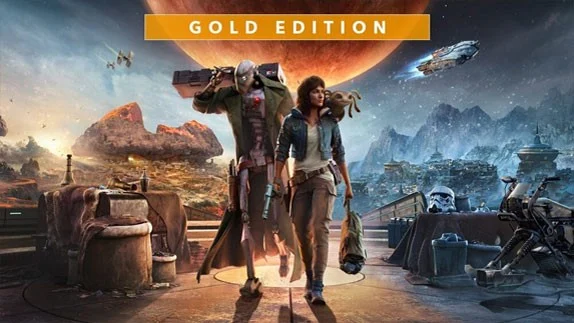
The game’s commercial disappointment was multifaceted. Technical issues at launch, including bugs, performance problems, and AI deficiencies, undermined player confidence and led to negative word-of-mouth. More fundamentally, the game’s stealth mechanics—marketed as a core feature—were criticized as underdeveloped compared to genre standards set by franchises like Dishonored and Hitman. The narrative failed to deliver meaningful consequences for the faction system choices players could make, reducing replayability and long-term engagement.
The financial impact was severe. Following the game’s launch, Ubisoft’s stock price fell more than 10% in just two days, pushing the company’s market capitalization below €2 billion for the first time in over a decade. The disappointment directly contributed to the delay of Assassin’s Creed Shadows from November 2024 to February 2025, as management sought to avoid repeating the technical issues that had plagued Outlaws.
XDefiant: The Live-Service Catastrophe
XDefiant’s trajectory from promising launch to shutdown represents one of Ubisoft’s most costly strategic failures. The free-to-play first-person shooter launched in May 2024 with significant fanfare and initially strong player numbers, positioning itself as a potential competitor to established franchises like Call of Duty and Apex Legends. However, the game’s retention metrics collapsed rapidly. Twitch viewership, a key indicator of player engagement for live-service titles, plummeted from over 203,000 concurrent viewers in May to just 1,440 by September 2024—a catastrophic 99% decline.
By December 2024, just seven months after launch, Ubisoft announced the game would shut down on June 3, 2025. The decision triggered immediate studio closures and layoffs affecting approximately 277 employees across Ubisoft’s San Francisco, Osaka, and Sydney studios. The shutdown also eliminated ongoing development costs, but represented a complete write-off of the game’s development investment and marketing expenditure.
The failure exposed fundamental flaws in Ubisoft’s approach to live-service gaming. The game suffered from overly complex progression systems that favored veteran players, creating barriers to entry for newcomers. Weapon balance issues plagued the experience from launch, while the decision to eliminate skill-based matchmaking—intended as a nostalgic return to ‘old-school’ gameplay—instead created frustrating experiences for casual players. Most critically, Ubisoft failed to establish a sustainable monetization model that could support ongoing development while remaining attractive to free-to-play users.
Skull & Bones: The Decade-Long Development Disaster
While not a 2025 release, Skull & Bones represents perhaps the most egregious example of Ubisoft’s operational dysfunction. Industry reports indicate the naval combat game consumed between €650 million and €850 million over a development period exceeding ten years—one of the most expensive development cycles in gaming history. The game, initially announced in 2017 as a spiritual successor to the beloved naval combat from Assassin’s Creed IV: Black Flag, underwent multiple complete restarts, engine changes, and creative direction pivots at Ubisoft.
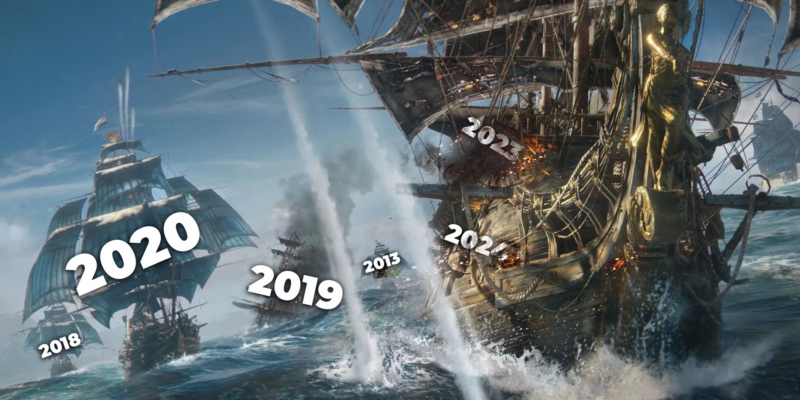
When it finally launched in February 2024, Skull & Bones received tepid critical reception and failed to generate significant player engagement. The live-service monetization imposed on top of a $70 base price drew particular criticism, as did the game’s shallow gameplay mechanics and lack of cohesive narrative. The project exemplified the dangers of ‘sunk cost fallacy’ in game development, where Ubisoft continued investing in a troubled project rather than cutting losses earlier.
The Stock Market Collapse: An 8-Year Destruction of Value
The magnitude of Ubisoft’s stock collapse is difficult to overstate. From a peak of approximately €100 per share in July 2018, when Ubisoft commanded a market capitalization of roughly €10 billion, Ubisoft’s stock has declined to €4.37 as of late January 2026—a staggering 95.6% decline. This represents the destruction of approximately €9.5 billion in shareholder value over eight years for Ubisoft investors.
The decline has accelerated dramatically in recent years. From a market capitalization of €12.17 billion in January 2021, the company’s value fell to €3.14 billion by January 2024, and further to €1.78 billion by January 2025. The January 2026 ‘major reset’ announcement triggered an additional 34% single-day decline, pushing the company’s market cap below €500 million—less than the cost of developing Skull & Bones alone.
This collapse places Ubisoft among the worst-performing major gaming companies of the past decade. For context, during the same 2018-2026 period, competitors like Electronic Arts maintained relatively stable valuations, while Take-Two Interactive and Activision Blizzard (prior to its Microsoft acquisition) saw significant appreciation. The divergence underscores that Ubisoft’s problems are company-specific rather than industry-wide, reflecting unique failures in Ubisoft’s strategy and execution.
Deutsche Bank’s February 2026 price target revision from €8.00 to €6.20—still 42% above the current trading price—suggests even the most optimistic analysts recognize the extent of the discount Ubisoft’s operational challenges have created. The wide gap between analyst targets and market price reflects profound skepticism about management’s ability to execute its turnaround plan.
Root Causes: Strategic and Operational Failures
1. Development Dysfunction and Project Mismanagement
Ubisoft’s inability to deliver polished, commercially successful games on predictable timelines represents the company’s most fundamental operational failure. The pattern is consistent: games are announced years before completion, undergo multiple delays, launch with significant technical issues, and fail to meet commercial expectations. This cycle has plagued virtually every major release from 2020 onward, from Watch Dogs Legion to Rainbow Six Extraction to Skull & Bones.
The Prince of Persia: The Sands of Time remake serves as a case study. Announced in September 2020 with a January 2021 release target, the game was delayed multiple times before being canceled entirely in January 2026—over five years after the initial announcement. During this period, the project reportedly changed development teams at least twice, representing wasted investment and organizational disruption.
Industry observers attribute these failures to several factors. Ubisoft’s large, globally distributed development structure creates coordination challenges. Ubisoft operates over 40 studios worldwide, often with multiple teams contributing to single projects. While this structure theoretically enables leveraging of specialized expertise, it appears to have created communication bottlenecks and accountability gaps for Ubisoft. The departure of key creative talent over recent years has exacerbated these issues, leaving projects without consistent vision or leadership.
2. Strategic Confusion: Chasing Trends Without Differentiation
Ubisoft’s strategic direction over the past five years can be characterized as reactive trend-chasing without clear differentiation or competitive advantage. Ubisoft’s aggressive pivot toward live-service games, exemplified by XDefiant and the live-service elements forced into Skull & Bones, came years after competitors had established dominant market positions. Rather than identifying underserved niches or leveraging unique strengths, Ubisoft attempted to compete directly with entrenched franchises like Call of Duty, Fortnite, and Apex Legends.
The company’s announcement that its new operating model would focus on ‘Open World Adventures and GaaS-native experiences’ while ‘accelerating investments behind player-facing Generative AI’ suggests continued strategic uncertainty. Open-world games have been Ubisoft’s core competency for over a decade, while the emphasis on AI-generated content comes as the broader gaming community has expressed significant skepticism about such implementations. This combination of playing to existing strengths while simultaneously betting on controversial emerging technologies lacks the focus needed to execute a successful turnaround.
The €1.16 billion Tencent investment in Vantage Studios, while providing crucial liquidity, also highlights Ubisoft’s diminished strategic autonomy. Tencent’s increasing influence over the company’s most valuable franchises likely comes with expectations around monetization, content strategy, and geographic focus that may not align with Western player preferences or creative team priorities.
3. Cultural and Leadership Crisis
The 2020 allegations of widespread sexual misconduct and harassment at Ubisoft created lasting damage to the company’s reputation and employee morale. While management promised structural reforms and accountability, the subsequent years have seen continued reports of toxic workplace culture and inadequate responses to employee concerns. The January 2026 firing of David Michaud-Cromp, a senior Assassin’s Creed designer, for publicly criticizing the return-to-office mandate exemplifies management’s confrontational approach to employee feedback.
Union representatives have characterized CEO Yves Guillemot’s leadership as disconnected from both the realities of game development and the needs of employees. The quote from Solidaires Informatique spokesman Marc Rutschlé is particularly damning: ‘At this stage, it seems clear to us that Yves Guillemot has no knowledge or understanding of his company or its employees.’ The fact that employees learned about major restructuring decisions simultaneously with the press, with no prior consultation despite legally mandated processes in France, demonstrates a fundamental breakdown in management-employee relations.
The company’s cost-cutting measures have disproportionately impacted rank-and-file employees while leaving executive compensation largely untouched. Workers report years without meaningful salary increases despite inflation, increasing workload expectations as teams shrink, and job insecurity as restructuring waves continue. This approach has created a demoralized workforce at precisely the moment when Ubisoft needs maximum creativity, commitment, and execution excellence.
The February 2026 Strike: Labor’s Response
The three-day international strike that began on February 10, 2026, mobilized over 1,200 Ubisoft employees across France and Italy, making it one of the largest coordinated labor actions in gaming industry history. Five French unions—STJV (Syndicat des Travailleureuses et Travailleurs du Jeu Vidéo), Solidaires Informatique, CGT, CFE-CGC, and Printemps Écologique—coordinated the action alongside workers at Ubisoft Milan. The timing was deliberate: February 12 coincided with Ubisoft’s scheduled release of first-quarter financial results following the restructuring announcement.
The unions articulated four primary demands. First, immediate cessation of the cost-reduction and layoff program, with particular emphasis on reversing the closure of Ubisoft Halifax and Stockholm. Second, comprehensive expansion of remote work policies rather than the mandated five-day office return. Third, meaningful salary increases for employees who have seen little or no wage growth despite years of inflation. Fourth, resignation of CEO Yves Guillemot, reflecting a complete loss of confidence in his leadership.
The unions’ public statements reveal deep cynicism about management’s restructuring rationale. The STJV characterized the Creative Houses structure as ‘a way to offload less profitable brands to structures that could be jettisoned off at some point,’ viewing it as preparation for further closures rather than genuine organizational improvement. They dismissed the promised ‘autonomy’ by noting that Guillemot unilaterally eliminated remote work in the same announcement that promised decentralized decision-making.
Perhaps most pointedly, unions challenged management’s narrative that workers should sacrifice for the company’s financial health: ‘Management is blind to the fact that it didn’t have a hand in building those billions-earning brands. The strike is a way to remind them that to make games, they need us, workers, much more than IP.’ This framing positions the strike not merely as defensive resistance to cuts, but as an assertion that creative workers, not management strategy, are the true source of Ubisoft’s value.
Financial Outlook and Restructuring Feasibility
Near-Term Projections: From Bad to Worse
Ubisoft’s financial guidance for fiscal year 2025-26 projects continued deterioration before any potential recovery. The company expects net bookings of approximately €1.5 billion, down from €1.84 billion in FY 2024-25 and representing a further 18% decline. The projected €1 billion operating loss—driven primarily by the €650 million in game cancellation write-downs—will push the company deeper into the red. Free cash flow is expected to be negative €400-500 million, requiring continued reliance on debt financing and the Tencent partnership proceeds.
The company’s debt position remains precarious. As of September 2025, Ubisoft carried net debt of approximately €1.15 billion. The accounting restatement that triggered debt covenant breaches has been addressed through early repayment of €286 million in loans, but this depleted cash reserves that could have supported operations or development. The company’s ability to access additional credit has been severely constrained by its deteriorating credit rating, with industry analysts estimating a CCC rating—indicating substantial credit risk and proximity to default territory.
The Tencent partnership, while providing €1.16 billion in capital through the Vantage Studios subsidiary, comes with significant strings attached. The structure effectively separates Ubisoft’s most valuable franchises into a partially independent entity, limiting the parent company’s ability to fully leverage these assets for broader corporate needs. Industry observers speculate that the arrangement includes provisions giving Tencent preferential rights in any future sale or restructuring scenario, potentially positioning the Chinese company to acquire Ubisoft’s core assets at distressed valuations.
The Restructuring Plan: Insufficient and Misguided
Ubisoft’s restructuring targets an additional €200 million in cost reductions over the next two years, bringing total cuts to €300 million beyond the €200 million already achieved. This would reduce the fixed cost base from €1.75 billion in FY 2022-23 to approximately €1.25 billion by March 2028. However, this target appears both insufficient to restore profitability given revenue declines, and potentially counterproductive if it further degrades development capabilities.
Simple mathematics reveals the challenge. With projected FY 2025-26 net bookings of €1.5 billion and an operating loss of €1 billion (admittedly inflated by one-time write-downs), the company’s underlying operational costs far exceed sustainable levels. Even achieving the full €300 million in additional savings would leave Ubisoft with a cost base of approximately €1.45 billion—requiring net bookings of at least €1.6-1.7 billion just to break even, assuming industry-standard gross margins of 60-65%.
Yet Ubisoft’s revenue trajectory is downward. The cancellation of six games eliminates future revenue opportunities. The delays of seven additional projects push revenue further into the future, creating near-term gaps. The company’s release calendar for the remainder of FY 2025-26 is sparse, with heavy reliance on Assassin’s Creed Shadows—a title whose February 2025 launch has already been jeopardized by the ongoing worker strike and previous delays that eroded marketing momentum.
Potential Scenarios: Ubisoft’s Uncertain Future
Scenario 1: Asset Sale and Dismantling (Highest Probability)
Industry experts including SuperData founder Joost van Dreunen increasingly view Ubisoft’s privatization and dismantlement as the most likely outcome. Under this scenario, the company would be acquired—potentially by Tencent, though other suitors including Microsoft, Sony, or private equity firms could emerge—and subsequently broken apart. Valuable franchises like Assassin’s Creed, Rainbow Six, and Far Cry would be retained or sold separately, while underperforming assets and studios would be shuttered.
This outcome would likely maximize value extraction for shareholders and creditors while proving devastating for employees. The current market capitalization below €500 million means Ubisoft’s enterprise value (including debt) is roughly €1.7 billion—a fraction of what its intellectual property could command in piecemeal sales. A strategic acquirer could reasonably argue that Assassin’s Creed alone, properly managed, justifies the purchase price of the entire company.
The Guillemot family, which maintains significant ownership and has resisted takeover attempts in the past, may no longer have the financial capacity or shareholder support to maintain independence. Reports suggest family members have explored various defensive strategies, but the depth of the current crisis may have exhausted options other than negotiating the best possible terms in a sale.
Scenario 2: Bankruptcy Restructuring (Moderate Probability)
If no acquirer emerges willing to pay even distressed valuations, Ubisoft could pursue bankruptcy protection to restructure its debts and operations. Under French insolvency law, this would likely take the form of either ‘sauvegarde’ (safeguard proceedings for companies in financial difficulty but not yet insolvent) or ‘redressement judiciaire’ (judicial reorganization for insolvent companies). This process would involve court supervision, potential debt-to-equity conversions for creditors, and forced asset sales of Ubisoft properties.
A bankruptcy restructuring could actually benefit long-term viability by eliminating unsustainable debt burdens and forcing rationalization of the studio footprint. However, it would also likely trigger significant additional layoffs, potential loss of key talent, and damage to developer and publisher partnerships. Games in development might be canceled or delayed further as the company focuses resources on the most commercially viable projects.
This scenario seems less likely than outright acquisition primarily because Ubisoft’s valuable IP makes it an attractive target for strategic buyers who would prefer to acquire assets outside of bankruptcy complexity. However, if labor conflicts escalate or key game releases fail to meet expectations, bankruptcy could become the path of least resistance.
Scenario 3: Successful Turnaround (Low Probability)
The scenario in which Ubisoft successfully executes its restructuring plan and returns to sustainable profitability requires several improbable developments occurring simultaneously. Assassin’s Creed Shadows would need to not merely succeed, but become a blockbuster hit generating well over €500 million in revenue. The company’s pipeline of delayed games would need to launch successfully with minimal further delays. The Creative Houses reorganization would need to rapidly deliver efficiency gains and hit rates on new projects. Labor relations would need to stabilize without further strikes or talent departures. And all of this would need to occur while competitors continue advancing their own franchises.
The probability of this scenario appears low given the company’s track record over the past five years. Ubisoft has consistently failed to execute on game development, missed commercial expectations, and demonstrated inability to adapt to market shifts. The departure of key creative talent, demoralized workforce, and management credibility crisis create headwinds that cannot be overcome simply by restructuring organizational charts or cutting costs.
Moreover, even if individual games succeed, Ubisoft faces the challenge of having burned through shareholder patience and creditor goodwill. The market has priced in expectations of continued failure, meaning the company would need to deliver not just adequate results, but sustained excellence over multiple years to restore confidence and valuation multiples.
Conclusions: A Cautionary Tale of Mismanagement
Ubisoft’s crisis represents one of the most dramatic collapses of a major gaming company in industry history. The 95% destruction of shareholder value since 2018, the inability to achieve profitability despite aggressive cost-cutting, and the eruption of worker strikes reflect fundamental failures of strategy, execution, and leadership that extend well beyond the cyclical challenges facing the broader gaming industry.
The proximate causes are clear: a series of commercially unsuccessful or outright failed game releases, from Star Wars Outlaws to XDefiant to Skull & Bones; development dysfunction that has prevented timely delivery of polished products; and strategic confusion that led the company to chase live-service trends without competitive differentiation. These failures occurred despite Ubisoft possessing some of gaming’s most valuable intellectual property and a global workforce of thousands of talented developers.
The deeper causes reveal more systemic problems. Ubisoft’s organizational structure, with over 40 studios operating in a complex matrix, appears to have created coordination costs that exceed the benefits of global scale. The company’s pursuit of growth through geographic expansion and portfolio breadth may have diluted focus and accountability. Leadership’s apparent disconnection from both creative teams and market realities has produced strategic decisions that satisfied neither investors nor employees.
Most fundamentally, Ubisoft’s crisis reflects a failure to recognize and adapt to changing industry dynamics. The gaming market has bifurcated between massive live-service games that capture thousands of hours of player time, and focused, high-quality narrative experiences that deliver concentrated value. Ubisoft’s traditional formula of open-world games with extensive maps, numerous collectibles, and dozens of hours of content falls awkwardly between these poles—too large and unfocused to compete with narrative experiences, too shallow and repetitive to sustain engagement against live-service alternatives.
The February 2026 worker strikes represent not merely a response to specific restructuring decisions, but a broader rejection of management’s approach to the crisis. By demanding CEO Guillemot’s resignation alongside policy reversals, unions are effectively arguing that the current leadership is incapable of navigating the company to recovery. Whether this assessment is correct remains uncertain, but the fact that over 1,200 employees were willing to strike during a period of mass industry layoffs suggests profound loss of confidence in the current trajectory.
Looking forward, Ubisoft’s options appear limited and uninviting. The restructuring plan, even if flawlessly executed, appears insufficient to restore profitability given continued revenue declines. The most likely outcome involves some form of sale or dismantling, whether through acquisition, bankruptcy restructuring, or piecemeal asset sales. The workers whose strike inspired this analysis will likely face continued job insecurity regardless of which scenario ultimately unfolds.
For the broader gaming industry, Ubisoft’s collapse offers important lessons. The live-service gold rush that dominated industry strategy from 2018-2024 has proven far more difficult to execute than anticipated, with the majority of attempts failing to achieve sustainable player bases. The pursuit of scale and global reach can create organizational complexity that undermines rather than enhances competitive position. And perhaps most critically, gaming remains a hits-driven business where creative excellence and player trust cannot be substituted by portfolio management, financial engineering, or cost reduction.
The irony is that Ubisoft helped pioneer many of the open-world mechanics and franchise-building approaches that define modern AAA gaming. Assassin’s Creed established templates for historical settings, parkour traversal, and persistent worlds. Far Cry defined the modern open-world action template. Rainbow Six revolutionized tactical shooters. The company’s failure lies not in lacking creative achievements, but in failing to evolve these franchises and operational approaches to remain competitive as player expectations and market structures shifted.
Whether Ubisoft can avoid dissolution and rebuild toward sustainable operations remains highly uncertain. What is certain is that the company’s crisis—from the financial collapse to the worker strikes—will be studied as a cautionary tale of how quickly even established gaming companies can falter when strategic vision, operational execution, and organizational culture all fail simultaneously.


