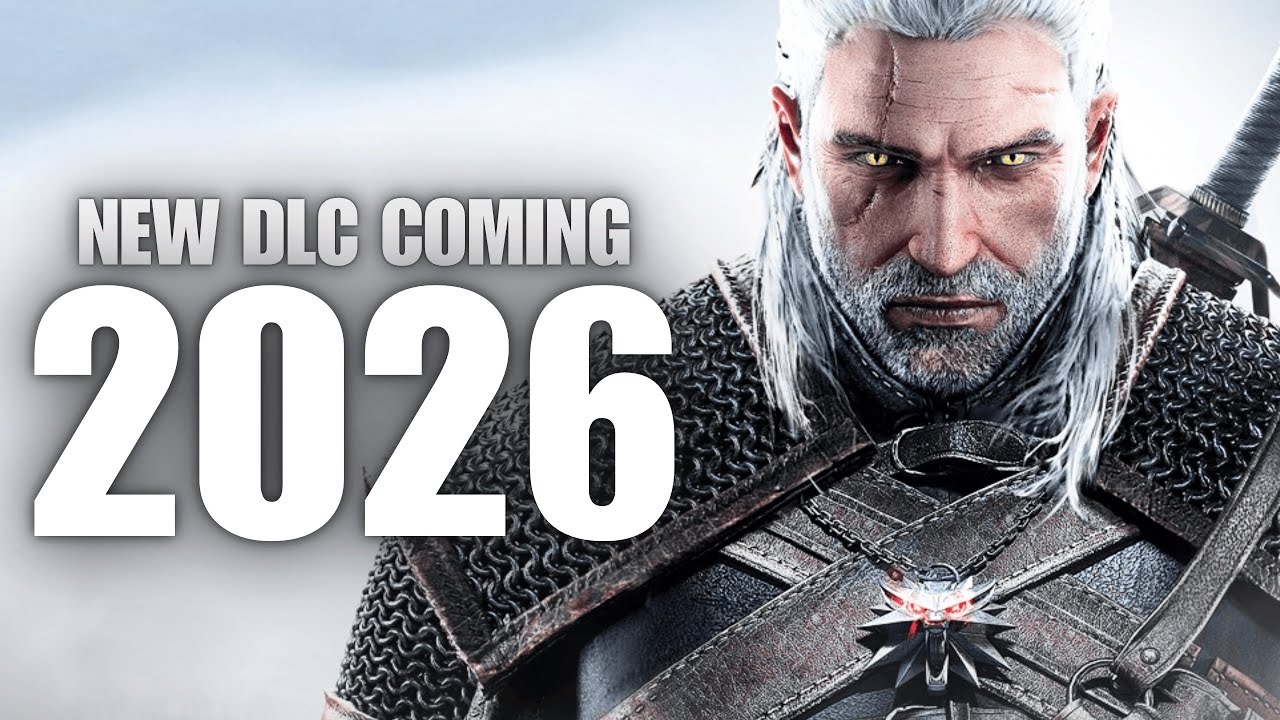
The $100M+ expansion needs to launch before Take-Two’s juggernaut destroys the market for every other AAA title. But CD Projekt’s disastrous track record with rushed releases makes this a high-wire act.
💬 Opinion/Analysis | March 17, 2026
Here’s the impossible math facing CD Projekt: They need $165 million in profit over the next five quarters. Their Witcher 3 DLC could deliver $50-200M depending on execution. But there’s a 60-day launch window in September 2026 — miss it, and GTA 6 will obliterate their market opportunity for good.
This isn’t hyperbole. When Take-Two’s $8 billion juggernaut drops on November 19, it will create a three-month commercial dead zone for every AAA title in the same genre. CD Projekt knows this. The market knows this. And now, according to Noble Securities analyst Mateusz Chrzanowski, the Polish gaming giant is quietly reshaping its release strategy around one critical insight: September 2026 is the only viable window.
CD Projekt (WSE: CDR) has a brutal choice to make: risk another quality disaster by rushing its unannounced Witcher 3 DLC, or watch GTA 6 obliterate the market opportunity entirely.
In a recent interview with Polish investment site Strefa Inwestorów, Chrzanowski laid out the strategic calculus: “I didn’t model the Witcher 3 DLC specifically, but like everyone else, I assume CD Projekt will try to release it before the new GTA launch to avoid that brutal period for other titles. So definitely before November, probably somewhere in Q3. I think September is the best window — summer has gamers on vacation, and September is a nice ‘back to school’ period.”
The stakes couldn’t be higher. The company needs to generate 700 million PLN ($165M USD) in cumulative profit over the next five quarters to hit its 2023-2026 management incentive target. This expansion — developed externally by Fool’s Theory with over 100 staff — is the most credible near-term catalyst to close that gap.
Witcher 3 DLC Release Date 2026
The GTA 6 Killzone: A Three-Month Dead Zone for AAA Releases
When GTA 6 launches on November 19, 2026, it will create a commercial black hole. Take-Two is projecting $8 billion in lifetime revenue from that single title. The marketing spend alone will dominate every gaming conversation, social feed, and livestream for months.
Any major release within 90 days of that date is committing financial suicide unless it operates in an entirely different genre or platform. The Witcher 3 DLC targets the exact same open-world action RPG audience on PlayStation, Xbox, and PC that will be locked into Los Santos. This is why timing isn’t just important — it’s existential.
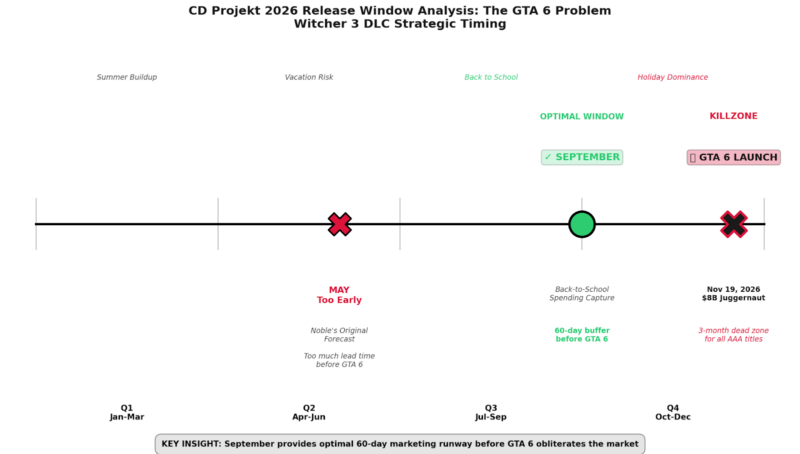
Strategic Release Windows: Why Timing Determines Success
Release too early (May-June): You give players time to finish the Witcher 3 DLC and move on before GTA 6 arrives, potentially missing the holiday spending wave entirely.
Release too late (November-December): You launch directly into the GTA buzzsaw and get buried. No amount of marketing will cut through.
September: Two full months of runway before GTA 6 drops. Captures back-to-school spending. Positions for holiday catalog sales. Stacks Q3 and Q4 revenue to maximize the profit target window.
Chrzanowski’s analysis acknowledges this reality but also notes flexibility: “However, it could go either way. They might come up with an idea to release in two or three months.” That two to three months timeline (May-June) aligns with Noble Securities’ December 2025 research report, which originally forecast a May 2026 launch. But Chrzanowski has clearly shifted toward a more conservative Q3 window.
Quality Control: The $2 Billion Lesson From Cyberpunk 2077
Here’s the tension: CD Projekt cannot afford to rush this. The Cyberpunk 2077 disaster is permanently etched into institutional memory.
The December 2020 launch was so catastrophically broken that Sony delisted it from PlayStation Store for six months. The company faced class action lawsuits, regulatory investigations, and a market cap collapse that took 18 months to recover. Investors remember. Management remembers. And they’re terrified of repeating it.
“They’ll have to make sure the quality from Fool’s Theory is fully satisfactory, so I prefer to assume it will be a bit later,” Chrzanowski said, referring to the shift from May to September.
How Fool’s Theory’s Development Timeline Affects the Witcher 3 DLC Release Date
This is where external development introduces risk. Fool’s Theory is a capable Polish studio — they co-developed Seven: The Days Long Gone and contributed to Divinity: Original Sin 2. But this is their first lead AAA project under one of gaming’s most scrutinized brands. CD Projekt will need aggressive QA oversight. Multiple rounds of certification. Console-specific testing across PlayStation 5, PlayStation 5 Pro, Xbox Series X/S, and PC configurations. And they’ll need buffer time for day-one patches that don’t embarrass them.
That’s why September makes sense: it gives them an extra 3-4 months of polish versus the May window, while still clearing the GTA 6 deadline with room to spare.
The $100M Revenue Potential: Why This Expansion Matters
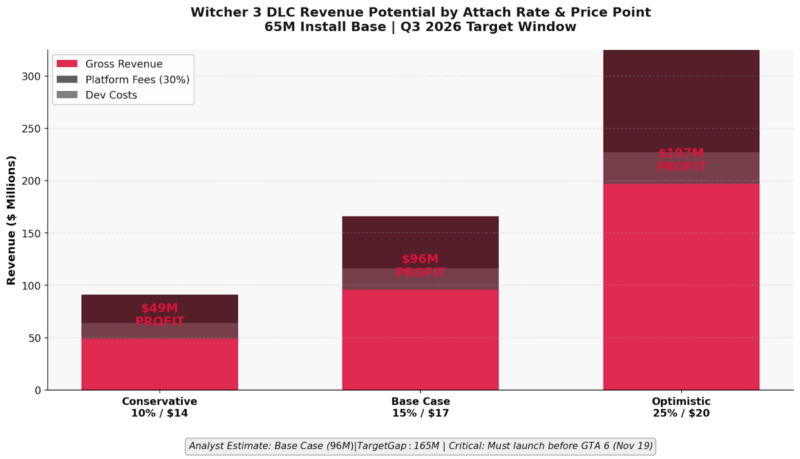
Let’s quantify what this Witcher 3 DLC could deliver. The Witcher 3: Wild Hunt has sold over 65 million copies — an absurd install base for a game that launched in 2015. If CD Projekt prices the expansion between $14-$20 and achieves industry-standard attach rates, the revenue potential is substantial.
Witcher 3 DLC Pricing Strategy: $14-$20 Price Point Analysis
Conservative scenario (10% attach rate, $14 price point):
• 6.5M units × $14 = $91M gross revenue• Less 30% platform fees = ~$64M net• Less Fool’s Theory development costs = ~$40-50M profit contribution
Optimistic scenario (25% attach rate, $20 price point):
• 16.25M units × $20 = $325M gross revenue• Less platform fees = ~$228M net• Less dev costs = ~$150-180M profit contribution
The real-world outcome likely lands somewhere in the middle, but even the conservative case meaningfully contributes to the 700M PLN profit gap. Context matters: Phantom Liberty, the Cyberpunk 2077 expansion, sold over 5 million units in its first year despite Cyberpunk’s damaged reputation. The Witcher IP has far stronger brand equity and an exponentially larger install base to monetize.
The Cyberpunk Mystery: Something’s Brewing Despite Official Denials
There’s a secondary wildcard in play: Cyberpunk 2077’s maintenance costs are at their highest levels since Phantom Liberty’s launch, according to Chrzanowski’s analysis of CD Projekt’s operational spending.
“As we look at the rising maintenance spending on Cyberpunk, which is the highest since the ‘Phantom Liberty’ debut, something is happening there in my opinion,” Chrzanowski noted. The work is being handled by Virtuos, the external studio that developed recent Cyberpunk patches. Industry sources on gaming forums have reported that voice actors from the original cast have been recording new dialogue lines.
CD Projekt publicly denied this on March 16, 2026, via the official Cyberpunk 2077 X account: “We are not planning any additional DLCs or expansions. If anything changes, we’ll let you know!” That last sentence — “if anything changes” — is corporate-speak for “we’re keeping our options open.”
Hours after the denial, CD Projekt announced a PlayStation 5 Pro technical update for Cyberpunk 2077 is coming soon. That’s a concrete deliverable that explains some of the maintenance spending — but not all of it. Even a modest paid addition at $9.99 with 15% attach rate across Cyberpunk’s 30M+ install base would generate $45M in incremental revenue. Not transformative, but material.
What Investors Should Watch
The key variable here isn’t whether the Witcher 3 DLC exists — it clearly does, based on Fool’s Theory’s confirmed headcount and VP of Investor Relations Karolina Gnaś’s November 2025 comments about “unannounced projects.” The variable is timing.
Bull case: September launch. Quality is strong. Attach rate hits 15-20%. Revenue contribution is $80M+. CD Projekt announces during the March 19 earnings call, giving five months of marketing runway. Stock rallies on clarity.
Bear case: Quality concerns force a Q4 2026 or early 2027 delay. GTA 6 destroys the market window. Attach rate disappoints due to franchise fatigue. Management credibility takes another hit. Stock consolidates or declines.
Base case: September launch happens, but attach rate lands at 10-12%. Revenue is meaningful but not transformative. CD Projekt still needs additional catalysts (Polaris updates, Cyberpunk content) to hit the incentive target. Stock remains range-bound.
The March 19, 2026 earnings call is the next major disclosure opportunity. Listen for any language around “unannounced projects,” “2026 content roadmap,” or “Fool’s Theory collaboration.” CD Projekt has historically used earnings releases as controlled moments to “drop the crumbs” of new information. If management wants to set investor expectations for H2 2026, this is when they’ll do it.
For more on how video game companies’ financial metrics signal success or failure, check out our breakdown of red flags in gaming balance sheets.
September 2026. That’s the window. CD Projekt knows it. The market knows it. And GTA 6 is the ticking clock forcing their hand.
📚 Related Reading:
• GTA 6 Delayed to November 19 — The $10M/Month Cost of Rockstar’s Perfectionism
• Take-Two Is Betting Its Entire Future on GTA 6 Selling $8B. Here’s the Math Behind That Bet
• 5 Financial Red Flags in a Video Game Company’s Balance Sheet
💬 Opinion/Analysis
Disclosure: The author does not hold any position in CD Projekt (WSE: CDR) or Take-Two Interactive (NASDAQ: TTWO).