
By Taimoor Khan | Published March 21, 2026 | 6 min read
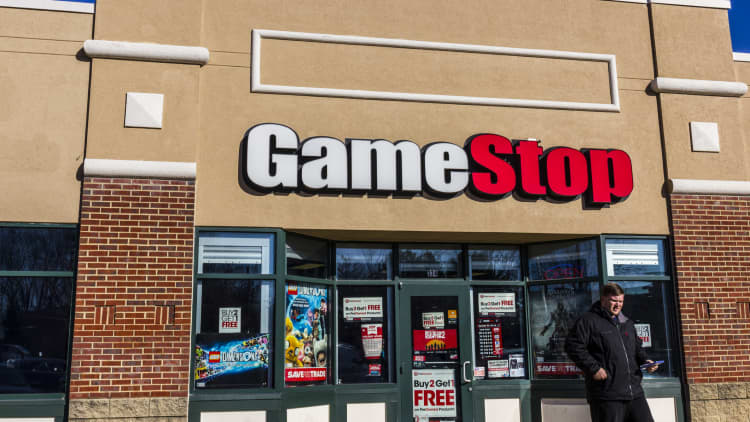
Ahead of GameStop Q4 2025 earnings, the company’s transformation under Ryan Cohen faces its most critical test yet.
With Q4 2025 earnings dropping Tuesday morning (March 24, 2026), Wall Street projects the video game retailer to post $1.47 billion in revenue, which represents a 15% year-over-year jump that would reverse three consecutive quarters of top-line pressure.
The stock has surged 14% year-to-date to $23.27, but the real question isn’t whether Cohen can beat estimates — it’s whether he can prove that GameStop is more than a cash-rich shell company eyeing an acquisition target.
GameStop Q4 2025 Earnings at a Glance
| Metric | Q4 2025 Estimate |
| Earnings Per Share (EPS) | $0.37 (vs $0.30 prior year) |
| Revenue | $1.47B (+15% YoY) |
| Report Date | March 24, 2026 (Pre-Market) |
| Stock Price (Current) | $23.27 (+14% YTD) |
| Expected Stock Move | ±6.68% ($1.55) |

What Wall Street Expects from GameStop Q4 2025 Earnings
Analysts are looking for GameStop to deliver a meaningful earnings beat while showcasing that Q3’s 4.6% revenue decline was a mere aberration rather than the start of a new trend. The consensus $0.37 EPS estimate represents a 23% growth from last year’s Q4, backed primarily by aggressive cost-cutting rather than top-line expansion.
According to TipRanks analyst data, the $1.47 billion revenue forecast would mark a dramatic reversal from Q3 2025’s disappointing performance. But here’s the problem: that estimate relies on holiday season console sales and collectibles momentum that may not materialize in a market increasingly dominated by digital distribution.
The Revenue Reality Check: Can GameStop Grow Again?
The biggest question isn’t whether GameStop can beat the $0.37 EPS estimate — cost cuts make that almost inevitable. The real test is revenue growth.
After posting $972.2 million in Q2 (up 21.8% YoY), the company watched that momentum fizzle out in Q3, with $821 million in sales (down 4.6%).
For Q4 2025 to hit $1.47 billion, GameStop needs to see a massive 79% sequential increase from Q3. While Q4 is traditionally the strongest quarter for video game retailers due to holiday shopping, this level of growth requires near-perfect execution across all product categories such as hardware, software, and the company’s growing collectibles business.

Ryan Cohen’s $8.8B War Chest: The Acquisition Wildcard
GameStop ended Q3 2025 with a stunning $8.8 billion in cash and marketable securities, nearly double the $4.6 billion the company reported a year earlier. Add in approximately $519 million in Bitcoin holdings and potential proceeds from warrant exercises, and Cohen has free cash flow of $11 billion for strategic acquisitions.
This matters because Cohen has publicly stated he’s pursuing what he calls a “very, very, very big” acquisition of a publicly traded consumer company. According to CNBC reporting from early February 2026, Cohen described the strategy as “way more compelling than bitcoin” and suggested it could be transformational for the company.
The $100 Billion Compensation Scheme That Changes Everything
Cohen’s personal incentives are perfectly aligned with aggressive M&A. His compensation package, which is potentially worth over $35 billion, only vests if the company reaches a $100 billion market capitalization (roughly 10x current levels) while achieving $10 billion in cumulative EBITDA.
There’s no realistic path to those numbers through organic growth in video game retail. The physical gaming market is shrinking at 15-20% annually as Sony, Microsoft, and Nintendo push digital downloads. Cohen needs a transformative acquisition to have any chance of hitting his targets—which means investors should expect concrete M&A announcements soon, possibly as early as this earnings call.

Infographic comparing: $8.8B cash + $0.5B Bitcoin vs $10.4B market cap with annotation showing M&A capacity
GameStop FY2025 Earnings: The Good, Bad, and Volatile
📊 Continue Reading: Gaming Finance Analysis
Deep-dive earnings analysis, M&A coverage, and stock insights for the gaming industry.
The 2025 story for GameStop has been one of extreme volatility. Let’s break down each quarter to understand the trajectory heading into Q4:
Q1 2025: The Foundation Quarter
Revenue of $732.4 million with diluted EPS of $0.09 showed Cohen’s cost-cutting discipline. The company took $35.5 million in asset impairment charges related to exiting international markets (Canada and France), signaling a ruthless focus on profitable operations. Gross margin hit 34.5%—among the highest in specialty retail.
Q2 2025: The Bitcoin Surge
This was GameStop’s strongest quarter. Revenue jumped to $972.2 million (+21.8% YoY), and net income exploded to $168.6 million—a 276% sequential increase. The company raised $2.7 billion through convertible notes and distributed warrants with a $32 strike price. Bitcoin holdings reached $528.6 million, and the cash position swelled to $8.7 billion.
Operating income turned positive at $66.4 million versus a loss the prior year, with SG&A expenses down to $218.8 million. The only concern? Gross margin compressed to 29.1% from Q1’s 34.5% due to product mix shifts.
Q3 2025: The Reality Check
Then came the wake-up call. Revenue fell to $821 million (down 4.6% YoY), though adjusted EPS of $0.24 beat the $0.18 estimate. This quarter exposed the fundamental challenge: GameStop can manage costs brilliantly, but it can’t control the structural decline in physical gaming.
Critical Metrics for GameStop Q4 2025 Earnings
Here’s exactly what to focus on when GameStop reports Tuesday morning:
1. Revenue Mix Breakdown: What percentage of Q4 revenue came from collectibles versus hardware/software? The collectibles business (trading cards, Funko Pops, gaming merchandise) carries higher margins and represents Cohen’s strategic pivot away from disc-based games.
2. Same-Store Sales Growth: With hundreds of store closures throughout 2025, comparable store sales tell the real health story. Are remaining locations actually more productive, or is the company just eliminating unprofitable outlets?
3. Operating Margin: Can GameStop maintain 5-6% operating margins while growing revenue? Q2 showed 6.8% operating margin on strong sales; Q3’s margin data will reveal if profitability holds during slower periods.
4. Bitcoin Strategy Update: Has Cohen added to the ~$519 million position, held steady, or begun liquidating for M&A funding? Any movement here signals acquisition timeline urgency.
5. Acquisition Timeline: Cohen’s commentary on the conference call (4:00 PM ET) matters more than the numbers. Any specificity around M&A targets, timing, or industry focus could move the stock 20%+ regardless of Q4 results.
6. FY2026 Guidance: GameStop historically doesn’t provide formal guidance, but any color on fiscal 2026 expectations—especially regarding the acquisition strategy—will be critical for valuation.

Estimated Q4 revenue breakdown: Hardware 40%, Software 25%, Collectibles 30%, Other 5%
GameStop Stock Valuation: Premium Price for Uncertain Future
At $23.27 with a 28.4x P/E ratio, GameStop trades at a significant premium to specialty retail peers (typically 15-20x earnings). This premium exists for three reasons: the $8.8 billion cash position ($19.50 per share in net cash alone), acquisition optionality from Cohen’s Chewy track record, and the persistent meme stock liquidity premium.
However, the valuation disconnect is stark. Wall Street’s consensus price target sits at $13.50 with a “Reduce” rating—implying 42% downside from current levels. Meanwhile, TipRanks’ AI analyst assigns a neutral rating with a $25 target, suggesting modest 7.4% upside.
Three Post-Earnings Scenarios for GME Stock
Bull Case ($27-$30): Revenue beats $1.50B, collectibles growth exceeds 40% YoY, Cohen provides concrete acquisition target details, operating margins expand. Stock breaks out above $25 resistance.
Base Case ($21-$24): Revenue in-line at $1.45-1.50B, EPS beats on cost discipline, vague M&A commentary. Stock consolidates in current range with high volatility.
Bear Case ($18-$20): Revenue misses below $1.40B, no acquisition clarity, Bitcoin liquidated without strategic purpose. Meme premium evaporates as reality sets in.
GameStop Insider Trading: Management Shows Conviction
Over the past 90 days, GameStop insiders have net purchased 517,000 shares worth approximately $10.9 million—a meaningful signal of confidence ahead of Q4 earnings. Director Lawrence Cheng added 5,000 shares at $22.87 in January, while General Counsel Mark Robinson trimmed 12,200 shares at $21.00, representing a 10.4% position reduction.
The aggregate insider buying suggests management believes the Q4 results will support current valuations and potentially provide positive surprises. According to SEC Form 4 filings, the timing of these purchases—clustered in January and February—suggests insiders anticipated strong Q4 performance or imminent acquisition news.
Video Game Retail Industry Trends: The Structural Challenge
GameStop’s Q4 2025 earnings don’t exist in a vacuum. The broader video game retail industry faces existential pressure from digital distribution, cloud gaming, and direct-to-consumer publisher strategies.
Physical game sales declined 22% in 2025 according to NPD Group data, while digital downloads and subscription services (Xbox Game Pass, PlayStation Plus) captured 78% of total game spending. This structural shift explains why Cohen’s collectibles pivot is essential—there’s no future in selling physical discs.
GameStop Q4 2025 Earnings: The Bottom Line
Tuesday’s GameStop Q4 2025 earnings report will likely show decent profitability driven by Cohen’s cost discipline. The company will probably beat the $0.37 EPS estimate. But the revenue number and acquisition commentary matter infinitely more than the earnings beat.
GameStop is no longer a video game retailer—it’s more of a special purpose acquisition vehicle with $8.8 billion cash searching for a transformative deal.
If Cohen somehow manages to deliver concrete M&A details on the 4:00 PM conference call, the stock could surge 20-30%. If he offers vague platitudes, brace for volatility and potential downside as the meme premium fades.
For investors: This is a binary bet on Ryan Cohen’s capital allocation skills, not a traditional retail investment. The ±6.68% implied move understates the real risk—this stock could easily swing 15-20% based solely on acquisition timeline commentary.


It’s interesting to see the continued optimism around GameStop’s growth, especially with Ryan Cohen’s involvement. I’m curious to see how they manage to maintain that revenue projection.