
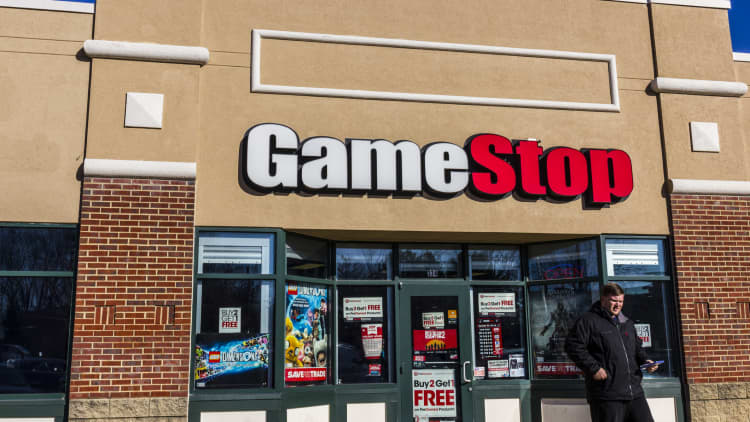
Two catalysts have pulled the GME stock back into financial media this week. First, Roaring Kitty’s brother hinted at repurchasing GME shares. Second, Michael Burry lifted his position to 13% of his portfolio. The resulting coverage has defaulted to the 2021 playbook — meme stock narrative, short squeeze potential, Reddit army mobilizing. That framing misreads what has actually happened to this company.
The social media catalyst is noise. A sibling’s hint is not Keith Gill returning. Burry’s move, however, deserves proper analytical attention — and his Substack post is clear on why: he believes he is buying near 1x tangible book value, meaning you are acquiring the business for nothing above what it holds in hard assets. That is a value investor’s framing, not a meme thesis.
Burry is not betting on a gaming renaissance. He is betting on Ryan Cohen not destroying $9 billion in cash.
Those are fundamentally different theses. Conflating them produces the kind of valuation fiction visible in the most-followed community narrative on Simply Wall St. — a $220 price target on a stock with $3.6B in declining revenue and zero sell-side analyst coverage.
FY2025 RESULTS: THE NUMBERS BEHIND THE GME STOCK NARRATIVE
GameStop’s FY2025 results, filed March 24, 2026, delivered genuine operational improvements — but the headline framing requires significant disaggregation.
| Metric | FY2025 | FY2024 | YoY Change |
| Net Sales | $3.63B | $3.82B | ▼ -5.0% |
| Operating Income | $232.1M | -$26.2M | Swing to profit |
| Net Income | $418.4M | $131.3M | ▲ +219% |
| Free Cash Flow | $597.3M | N/D | Strong |
| Cash & Securities | $9.01B | $4.77B | ▲ +89% |
| SG&A Expenses | $910.2M | ~$1.13B | ▼ -19.5% |
| Bitcoin (Q4 close) | $368.4M | N/A | ▼ from ~$500M |
Source: GameStop Corp. 8-K, SEC EDGAR, March 24, 2026
The 219% net income increase sounds transformational. It is partly real and partly accounting. Operating income improvement — from a loss of $26.2M to a gain of $232.1M — reflects genuine cost discipline. SG&A fell another 19.5%, store count continues to shrink, and the remaining footprint is generating better unit economics.
But the $9.01B balance sheet is not organic. It was built with $4.2B in zero-coupon convertible notes issued throughout FY2025 — debt financing layered on top of $597.3M in genuine free cash flow. GameStop leveraged its own meme-stock volatility, issuing equity and converts when its share price was elevated, and parking the proceeds. The financial engineering is genuinely impressive. It is not, however, evidence of a thriving operating business.
The $9 billion war chest is not evidence of a thriving business. It is evidence of a CEO who understood how to monetise a meme — and had the discipline to save what he raised.
THE BITCOIN POSITION: TREASURY STRATEGY OR SPECULATIVE DRAG?
GameStop’s board unanimously approved Bitcoin as a treasury reserve asset in March 2025. By Q4 FY2025, the company held a position that peaked near $500M — and generated a $151M mark-to-market loss in the quarter, closing at $368.4M.
The Bitcoin treasury narrative borrows from MicroStrategy’s playbook. But MicroStrategy’s entire corporate identity is the Bitcoin bet — investors who own it understand exactly what they are buying. GameStop’s primary stated purpose remains retail operations and a pending major acquisition. Embedding a volatile crypto position into a cash pile designated for corporate M&A introduces compounding risk, not balance sheet enhancement.
At approximately 4% of total cash at quarter-end, the position is not existential. But it adds mark-to-market volatility to earnings that makes forward modelling harder — and adds one more layer of opacity to a company that already holds zero earnings calls and provides no forward guidance.
THE REAL INVESTMENT QUESTION: WHAT DOES COHEN BUY?
Ryan Cohen has publicly stated his ambition to build a $100 billion company through a ‘big’ acquisition — describing it as ‘genius or totally foolish.’ The warrant dividend issued in Q2 FY2025 explicitly cited ‘potential acquisitions’ as a use of proceeds, with up to $1.9B in potential gross proceeds if warrants are fully exercised. Cohen holds no earnings calls and has provided no forward guidance across any quarter of FY2025. That silence is the strategy.
The most-discussed target is eBay, currently carrying a market cap of approximately $39.9B on $11.1B in trailing revenue. That deal at current prices is not executable on GameStop’s balance sheet without massive additional dilution or debt that would erase the foundational thesis for holding the stock. A $40B acquisition requires either a partner, a dramatically cheaper eBay, or equity issuance that reshapes GME’s capital structure entirely.
Smaller targets are more plausible and analytically more defensible. A disciplined tuck-in in the $2–5B range — a collectibles platform, a digital marketplace, or a gaming-adjacent commerce business — would be executable against the war chest, capital-light relative to the balance sheet, and synergistic with the existing retail footprint. That is the base case worth modelling.
Cohen has been silent for four consecutive quarters. The next move may be announced without being telegraphed.
VALUATION: DISMISS THE $220 TARGET, BUILD FROM ENTERPRISE VALUE
The most-followed community narrative on Simply Wall St. places a $220 price target on GME. The methodology: assume rapid earnings growth, apply a rich future profit multiple, arrive at a 10x return from current levels. This is not institutional analysis — it is aspiration dressed in DCF clothing.
The correct framework is enterprise value analysis. At $23.22, with a market cap of approximately $9.3B and $9.01B in cash, the implied enterprise value of the operating business is roughly $290M. The operating business generated $232M in operating income in FY2025. That means you are paying approximately 1.25x operating income for the retail and gaming business — while getting $9B in deployment optionality for near-nothing.
The P/E of 24.9x, frequently cited as a premium to the 19.6x specialty retail average, is an artifact of how net income is constructed — not a reflection of operating earnings power. Strip out financial engineering, asset movements, and Bitcoin mark-to-market, and the multiple on core operations looks very different.
Our scenario modelling:
| BEAR | BASE | BULL | |
| Bitcoin Impact | BTC -50%, ~$185M loss | BTC flat, neutral | BTC +50%, ~$185M gain |
| Acquisition | Overpriced deal destroys capital | No deal / small tuck-in | eBay at disciplined multiple |
| Retail Revenue | -15% to -20% YoY decline | -8% to -10% decline | -5% or better |
| EV / Cash Burn | Net negative (BTC + deal) | EV near zero, preserved | EV expands on deal synergies |
| Target Price | $12 – $15 | $18 – $24 | $35 – $50 |
| Implied Return | -35% to -48% | -4% to +3% | +51% to +115% |
The base case — HOLD — reflects the reality that at near-zero enterprise value, GME is not obviously expensive. But the absence of transparency, the Bitcoin volatility drag, and the uncertain acquisition path mean there is no compelling catalyst to overweight the position relative to higher-conviction names in the sector.
RATING TRIGGERS
| Direction | Trigger | Target Range |
| UPGRADE to BUY | Credible acquisition at ≤12x target EBITDA | $35 – $50 |
| UPGRADE to BUY | Bitcoin position liquidated; capital reallocated | $30 – $40 |
| DOWNGRADE to SELL | Acquisition at excessive premium (>15x EBITDA) | $12 – $15 |
| DOWNGRADE to SELL | Bitcoin position grows above 10% of total cash | $14 – $18 |
| DOWNGRADE to SELL | Equity dilution resumes for non-acquisition purposes | $10 – $14 |
THE GAMING BUSINESS: A MANAGED DECLINE, NOT A MOAT
For completeness, GameStop’s core gaming operation deserves its own assessment — because PPF’s mandate is understanding public gaming companies, not just their balance sheets.
The core business is in structural decline. Digital distribution has broken the physical game retail model at the foundation. The company’s response — aggressively shrinking the store count, pivoting to collectibles, extracting cost from every remaining location — is the correct playbook for a managed decline. It is not a growth strategy.
The collectibles segment provides partial offset. Pop culture merchandise, trading cards, and licensed products carry better margins than software and hardware accessories, and are less exposed to the digital shift. But the total addressable market for GameStop’s collectibles is capped by a shrinking retail footprint.
This is not a gaming investment. The gaming operations exist to fund the transformation. Investors buying GME because they are bullish on gaming are buying the wrong thesis. For investors who want genuine exposure to gaming sector growth, our TTWO analysis and the forthcoming EA scorecard offer more direct sector exposure with clearer earnings catalysts.
INVESTMENT DISCLAIMER
This article is published by PressPlayFinance.com for informational and educational purposes only. Nothing in this article constitutes financial advice, investment advice, or a recommendation to buy or sell any security. All data sourced from SEC filings, public market data, and cited third-party sources. Taimoor Khan and PressPlayFinance.com hold no position in GME as of the date of publication. Past performance is not indicative of future results. Always conduct your own due diligence and consult a qualified financial advisor before making investment decisions.


That’s a really interesting point about Burry’s continued interest. It seems like the potential for short squeeze action is still a significant factor to consider.